The Overlooked Email System That Builds Real, Lasting Trust
There was a time I thought the answer to growing this business was creating more products. I kept adding offers and promotions until things became far more complicated than they needed to be. Eventually I realised the complexity wasn’t helping me grow; it was slowing me down.
If your own list of offers has grown the same way, stripping it back usually helps more than adding one more.
I think about that lesson often, especially when I hear the same question from people starting out: “How do I get customers?” The instinct is always to build one more thing: another launch, another promotion, another product to promote it with.
But the steadiest income rarely comes from doing more, in my experience and in the businesses I read about. It comes from building one thing properly, once, and letting it keep working. An email sequence is one of the clearest examples of that idea in action.
Why More Emails Is Not The Same As More Income
Most people running an online business tie their income to how many emails they personally write that week. Skip a week, and the sales slow down right alongside you.
That is exhausting, and it is also the kind of complexity I talked myself out of years ago. Adding more offers won’t grow your business. It will just give you more to manage.
An email sequence, written once and left to run, works differently. New subscribers meet the same emails in the same order, whether they join today or in six months. Nobody has to sit down and write something fresh just to keep the business moving.
Think about a subscriber who joins your list on a quiet Tuesday versus one who joins during a busy launch week. With a finished sequence, both get the same careful introduction and the same reason to stick around. With ad-hoc emails, one of them might get nothing for a fortnight simply because you were too busy to sit down and write.
That is the same shift I eventually made with my own products, and the same shift worth making with yours. Fewer moving parts, built properly, beats a pile of half-finished ones every time. The same rule applies whether it is your product list or your inbox.
The Trap Of A Sequence That Never Gets Finished
Here is where most people trip up, and it is the same trap I fell into with products, not emails.
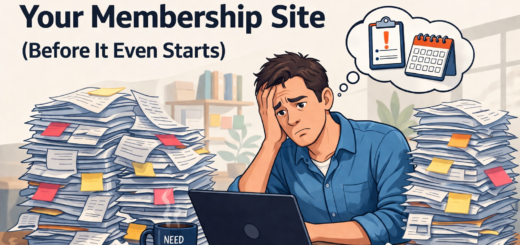
They write the first few emails, feel pleased with themselves, then get pulled back into the day-to-day. The sequence sits half done in a folder, doing nothing for you or the people on your list.
Picture the folder itself: three finished emails, then a fourth left half-written for months, quietly reminding you of the job you meant to finish.
A half finished sequence cannot sell for you. Neither can a half finished product.
I learned that the hard way with offers I never properly completed. A handful of finished emails, written with care and placed in the right order, will do more for your business. A stack of unfinished ideas never will.
What A Finished Sequence Looks Like
Picture a run of emails, spread across a few weeks, each one written with a single clear job. Some open a small gap of curiosity. Some teach one small, useful thing on their own. Some simply remind the reader why they joined your list in the first place.
Every subscriber meets the same run, in the same order, automatically. Nobody has to remember to write to them that week.
Nick James, who has taught email marketing since 2001, talks about a version of this he calls the Freemium Formula. It is a written six-week sequence that treats every new subscriber the same way, whether they joined this morning or eighteen months ago.
The thinking behind it lines up with something I believe strongly. A small, trusted list built on one finished, well-considered sequence will outperform a huge list managed with rushed, one-off messages.
Building Something Small Enough To Finish
If “I can’t do tech!” is the thought that stops you before you start, this is worth hearing: an email sequence does not need to be clever. It needs to be finished.
Start with three emails. Not eighteen, not fifty. Three, written properly, each with one clear job.
The first tells a new subscriber exactly what problem you help with, and proves it fast with one small useful idea. The next two build on that, one step at a time.
Email one might simply welcome them and point to the single most useful thing you have ever written on the subject. Email two could walk through a small win step by step, something they can act on in ten minutes. Email three might explain what you offer next and why it fits naturally, without any pressure attached.
Finish those three completely before you touch a fourth. I have shared a bit more on building things this way, one finished piece at a time, in other articles I have shared recently. The same idea keeps showing up.
Why This Matters More As Your List Grows
The temptation, once your list starts growing, is to add more.
More sequences, more products, more promotions running at once.
I understand that temptation better than most. It is exactly what took my own business from something simple into something far more complicated than it needed to be. Watch for the same pull in your own business before it takes hold.
A finished sequence does not need constant additions to keep working. It needs to be left alone to do the job it was built for. Every new subscriber from that point on meets the finished version, not a work in progress you are still tinkering with.
That is, in my experience, the real difference between your business feeling like a treadmill and one that feels like it is working for you.
Where To Go If You Want The Full Structure
If you like the idea of a finished sequence doing this kind of work quietly in the background, this is worth knowing. Nick James put together a full framework for exactly that.
It is called Lazy Way To Email Riches, and it walks through building a six-week sequence, email by email. It also covers the popup and landing page pieces that feed new subscribers into it in the first place.
Most people trying to write a sequence from scratch get stuck on the same three questions: what to say first, how long to make it, and when to mention anything at all. A structure built by someone who has already answered those questions removes the guesswork, which is often the real reason a sequence never gets finished.
It is not something I have built myself, so I will not pretend to have used it. But if you want to go further than three emails written on your own, it is worth a look: Lazy Way To Email Riches.
Start Smaller Than Feels Comfortable
You do not need a big list before any of this matters. A finished sequence sells just as well for your fiftieth subscriber as it will for your five thousandth.
Build it small. Finish it properly. Then leave it alone to do its job, the same way I eventually learned to leave my products alone instead of endlessly adding to them.
That is the whole shift, really.
Not more hours. Not a bigger list. One finished piece of work, doing the job that used to take you all week.
Until next time, keep building.
SHANE
Can You Click Send?
“If You Can, Enter Your Details Below And I’ll Show You How To Make A Life-Changing $8,000+
A Month From Home…
Privacy Policy: We value your privacy. You can unsubscribe from receiving future emails with 1 click at any time.